


With our time-honored commitment to client care, AMP builds an electrical testing program around the equipment you actually have. Acceptance testing before you energize, maintenance testing to trend it over its service life, and a technician on the phone when something goes wrong at two in the morning.
Acceptance & maintenance testing
Any process-driven industry benefits from routine testing of its electrical power system. The work splits into two halves, and most facilities need both.
Acceptance testing
Performed before you depend on the equipment for production. It confirms proper installation, verifies the gear arrived free of factory defects, and establishes the baseline every future test is measured against.
Maintenance testing
Picks up where acceptance leaves off, trending the condition of your gear over its service life so problems surface on your schedule instead of during a shift.
Who performs it
NETA-accredited field technicians work to published industry standards with a safety-first approach. They will also explain the results to your engineers afterward.
Transformers
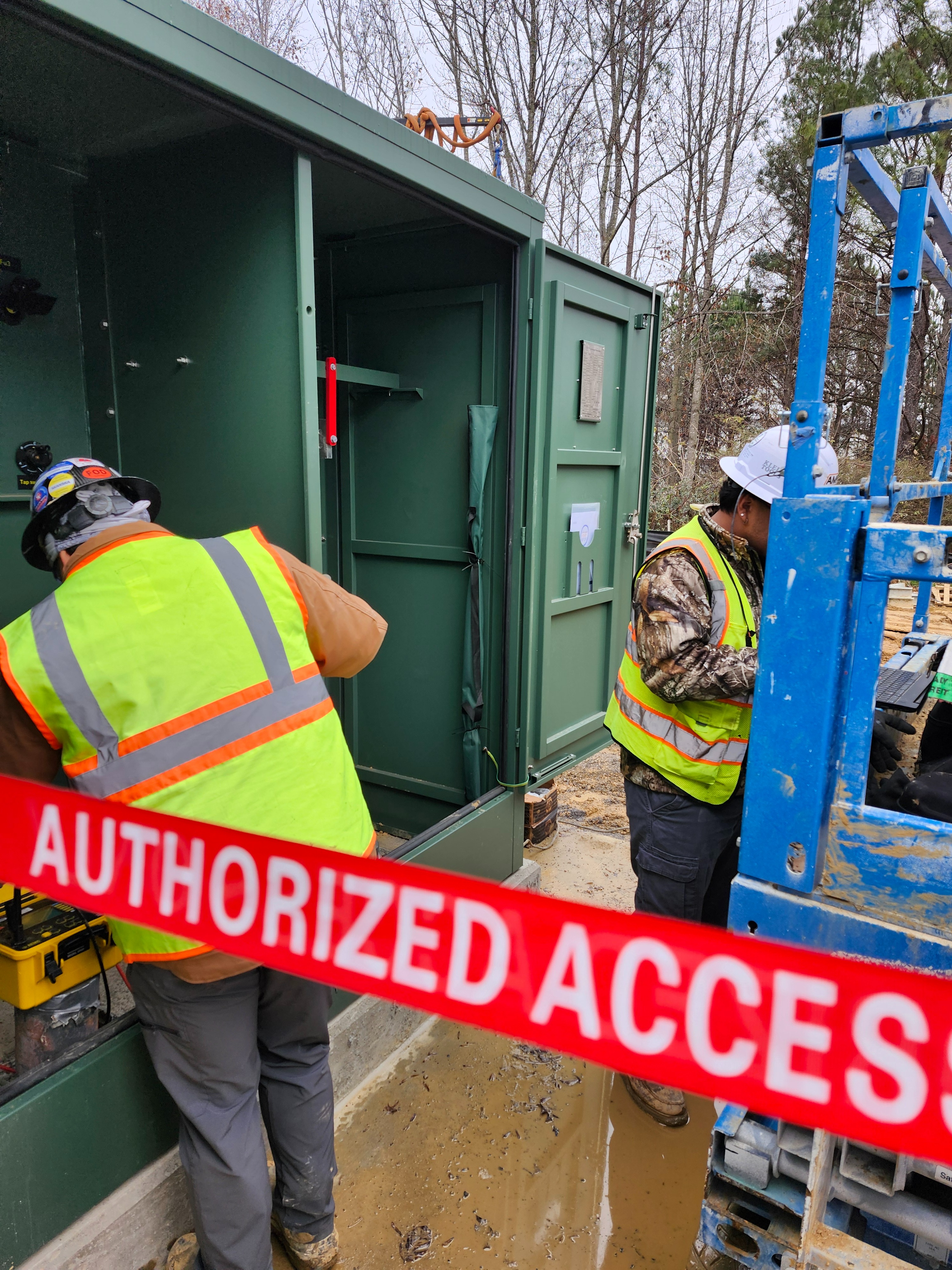
Transformers are a fundamental part of any electrical system. They are what let us generate, distribute, and use power at many different voltages. Power is typically generated at low to medium voltage, then stepped up through a generator step-up (GSU) transformer to a much higher transmission voltage so it can travel long distances with lower losses. At the utility delivery point it is transformed again to a distribution voltage, and at your site it is transformed once more to whatever your equipment requires, through a pole, padmount, dry, cast coil, or unit substation transformer.
Even in the simplest scenario, transformers appear throughout the power system. Knowing how to commission, trend, and maintain them is what reduces the hazard to life and property that comes from a transformer failure.
Acceptance testing and commissioning of new or recently relocated transformers is especially critical: a great deal can go wrong during transport and installation, and nearly all of it is detectable through thorough acceptance testing. AMP works to the ANSI/NETA ATS standard for acceptance testing specifications, referencing IEEE, NFPA 70B, and IEC where applicable.
Transformer tests we perform
- Insulation resistance
- Winding resistance
- Turns ratio
- Power factor
- Sweep frequency response analysis
- Insulating oil sampling and analysis
Circuit breakers
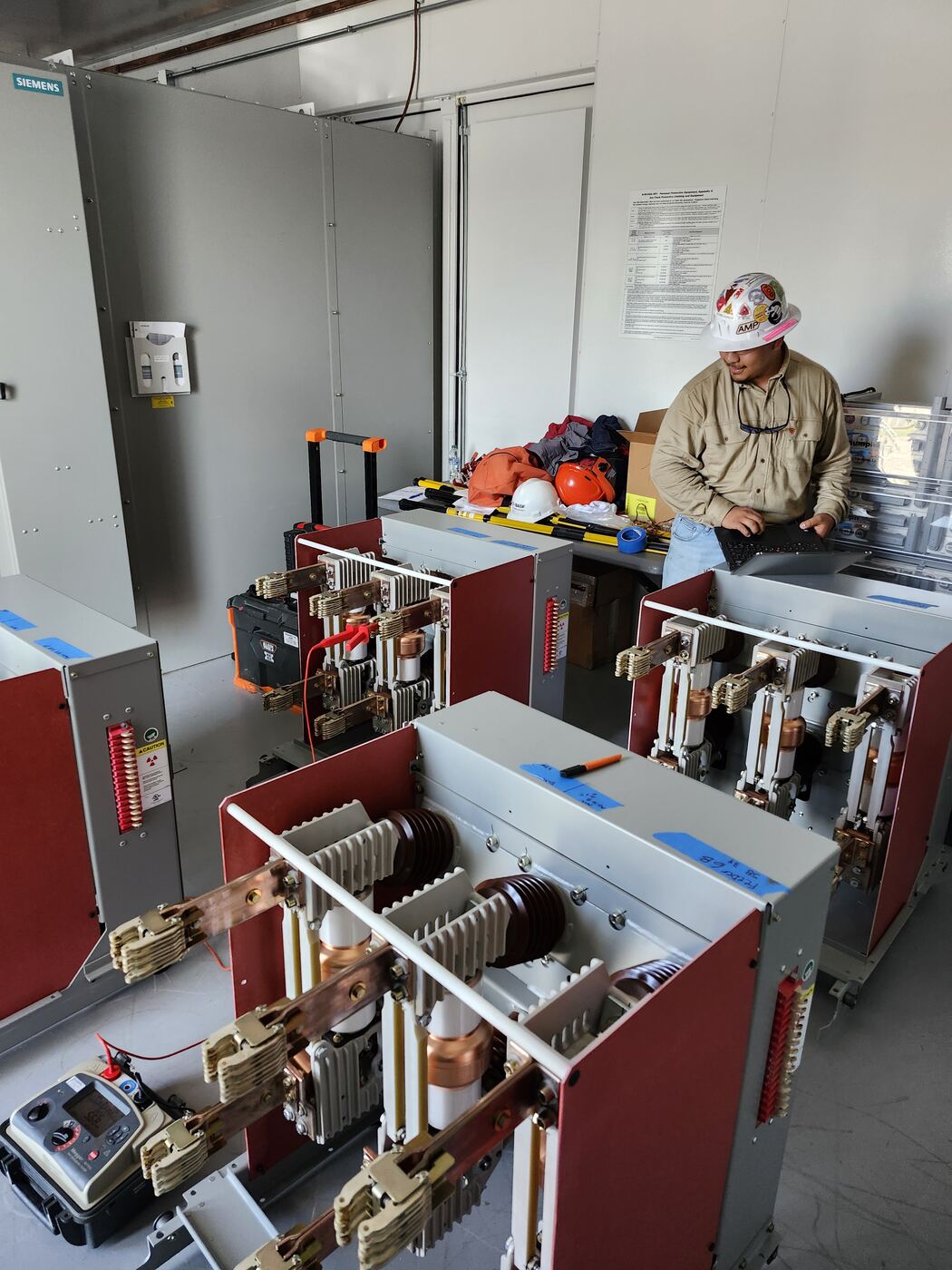
Circuit breakers turn power on and off while providing overcurrent protection. What sets them apart from switches and fuses is that they can be reset, controlled remotely, and given logic functions as part of their operation. A switch opens and closes but provides no overcurrent protection on its own; a fuse protects but cannot be reset. Combining the two still leaves you without the ability to reset and immediately restore power. That makes breakers the right choice anywhere your system may see frequent faults, anywhere fast restoration matters, or anywhere you need logic tied to the state of the power.
Breakers range from a simple thermal-magnetic trip, which uses the heat of the current flowing through it to instigate a trip, all the way to microprocessor-controlled protective devices with nearly infinite adjustability. Low-voltage breakers typically have their protective trip devices built into the frame or chassis, designed and installed together at the factory. Medium- and high-voltage breakers depend on external or cabinet-mounted protective relays to instigate their trips, either specified with the breaker or as part of a larger substation protection scheme that includes differential and distance feeder protection.
We test the breaker and the protection around it: contact resistance, timing, insulation resistance, primary and secondary injection, and verification of relay settings against your coordination study.
Stand-by generators
Standby generators are a staple wherever critical systems depend on a constant supply of electricity. They are the power source during an outage or emergency, which is exactly why they need regular maintenance, and why it matters to have a contractor who can maintain, repair, and advise on them.
Just as important as the generator is the transfer means. Whether it is paralleling gear, peak-shaving controls, or synchronization relays, our technicians maintain and test the equipment so it operates when it should, as it should. A standby system is really three pieces of equipment, and a failure in any one of them reads the same way to your facility: no power.
Prime mover
Every generator relies on some form of mechanical power to convert into electrical energy. Routine maintenance on the prime mover is critical to a system that will actually deliver power when called on.
Generator
The device that outputs electrical power when spun by the prime mover. Generators have windings much like an electric motor, and we treat them from a maintenance standpoint the way we treat your critical motors. Resistance measurements are taken across bolted connections, and insulation resistance tests are performed in accordance with ANSI/IEEE Standard 43.
Transfer switch
Manual or automatic, it changes the electrical path from normal utility power to emergency generator power. Following ANSI/NETA MTS, we perform visual and mechanical inspection plus, at minimum, contact resistance across each switchblade assembly; one-minute insulation resistance tests on each pole; and a dielectric withstand test.
Electrical disaster recovery
Disasters strike when we least expect them, and even the best-prepared facilities get caught off guard. Whether it is a tornado, hurricane, flood, or fire, call AMP to get your electrical power system restored to working condition quickly.
We start with a full system assessment so the critical decisions about repair versus replacement can be made with real information. Making AMP your first call saves time and effort by prioritizing what is salvageable and what has to be replaced. We bring order to your chaos, with quick turnaround on servicing equipment and some of the shortest lead times available on new or refurbished gear.
- On-site refurbishing
- Water damage mitigation
- Fire restoration
- Fast lead times on new equipment
- Hard-to-find obsolete replacements
- Retrofitting obsolete equipment with modern replacements
Emergencies do not keep business hours. Call (256) 513-8255 and we will get a technician moving.
