



AMP has acquired Controls & Electrical Design Services, Inc. (CEDSI) of Madison, Alabama, expanding our engineering capability well beyond power system studies. Founded in 1993, CEDSI brings decades of controls and design experience to the AMP team, including:
- Industrial process control and machine control systems
- Control panel fabrication with UL 508A certification
- Electrical design, CAD services, and power systems analysis
- Construction, installation, and startup support
Together we serve automotive, chemical, fiber, pharmaceutical, pulp and paper, recycling, grain handling, packaging, tire and rubber, and water/wastewater clients.
Arc flash study
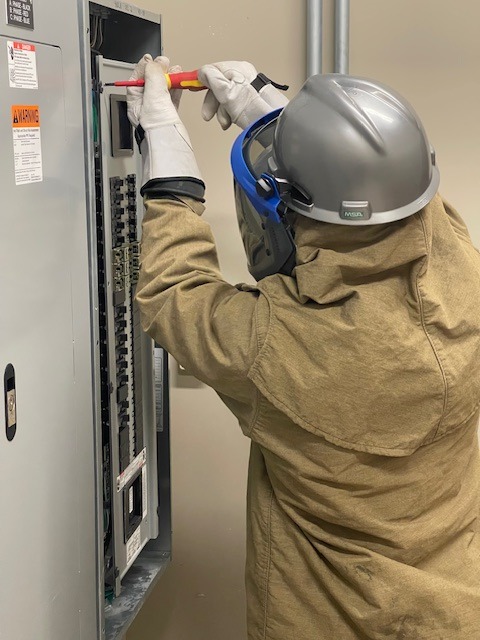
An arc flash, or arc blast, is a type of electrical explosion that results from a low-impedance connection to ground or to another voltage source. An arc flash study is a requirement of NFPA 70E Article 130.5, with the equipment labeling requirements spelled out in the same article. Commissioning that study is the responsibility of the facility owner, and it safeguards every employee who may come into contact with a hazardous work condition.
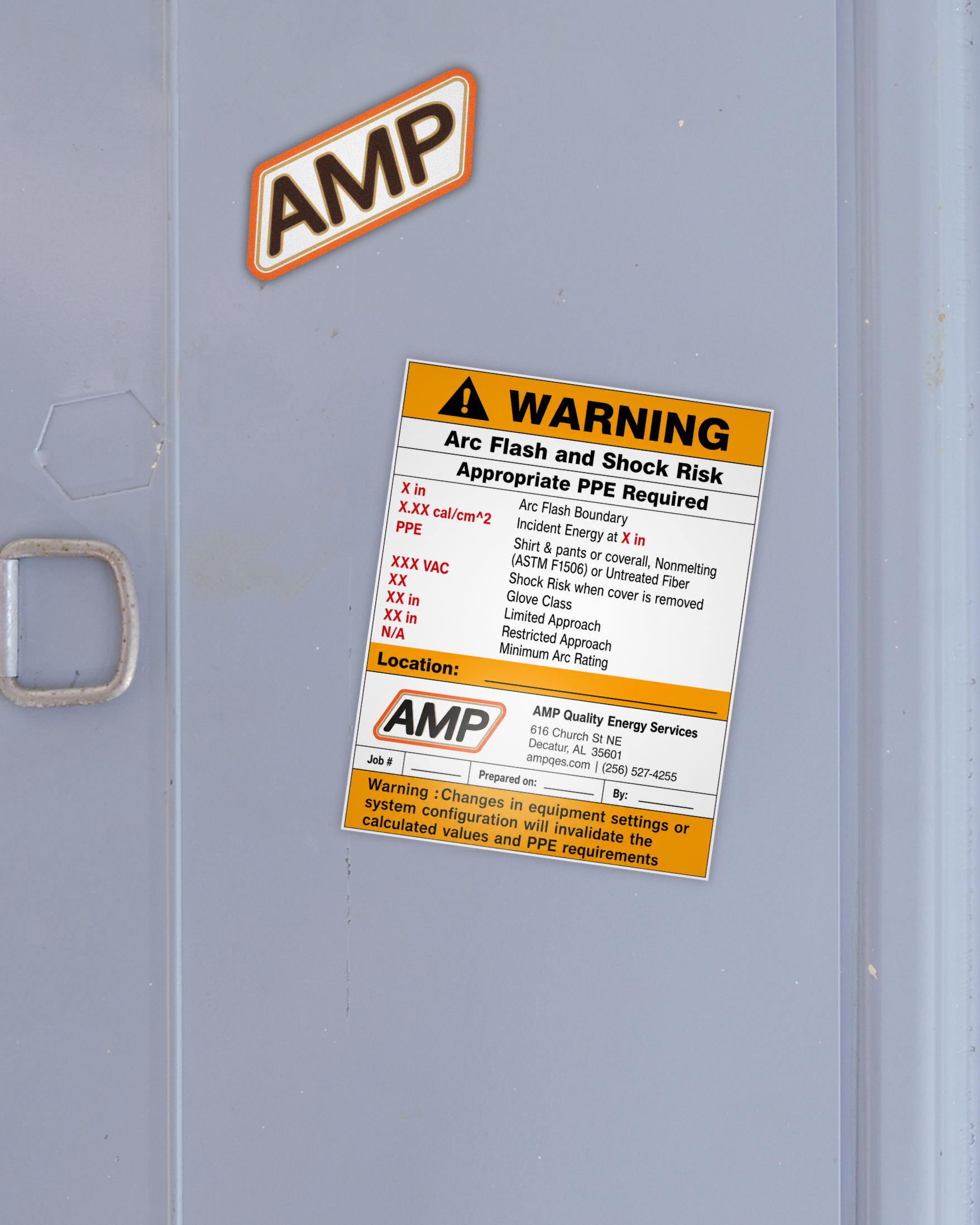
Understanding the potential for an arc flash lets us label your equipment with the appropriate identifiers: the incident energy available at each device, and the PPE required to protect anyone working on or near it. Those labels also become the backbone of your arc flash training program.
When to update: a study is required when a new system is built, and it must be updated whenever a major change is made to an existing system, never exceeding five years between updates.
Device coordination
Also known as a selectivity study. Every protective device (relay, circuit breaker, or fuse) has a trip curve specific to that model. Those curves can be set so that in a fault condition the downstream device operates before the upstream ones, which de-energizes only the affected branch instead of the entire facility.
The safety half matters just as much: device settings need to be quick enough to minimize fault time so a potential fault clears as fast as possible, which also limits property damage. Coordination of protective devices is required by NFPA 70B Article 9.3 and by ANSI/IEEE.
One caveat worth stating plainly: the coordination curves used in software models assume properly maintained and lubricated equipment. A study is only as good as the condition of the gear it describes, which is why coordination work pairs naturally with field testing.
Load study
Load-flow studies are a requirement of NFPA 70B Article 9.4 and ANSI/IEEE 242. A load-flow study shows the direction and amount of power flowing from every available source to every load in the facility, giving the people working with or around that equipment an accurate picture of how much current is present and which locations are most and least heavily loaded.
When to update: any time the load flow changes: swapping motors or motor horsepower, changing transformer size or impedance, altering operating configurations, or adding or removing power-factor correction capacitors or loads.
Short circuit analysis
A short circuit analysis is required by NFPA 70, NEC Sections 110.9 and 110.10, and it is closely tied to the load study, device coordination, and arc flash analysis. A potential short circuit represents a significant amount of destructive energy. That energy can be mitigated by coordinating protective devices and by confirming your equipment is rated to interrupt and withstand the available fault current.
When to update: any time a change is made to the existing system. Just as important, the current analysis needs to be on hand for your facilities engineer or supervisor, so they can make informed decisions about the system with the results in front of them.
Each study is tailored to your equipment and documented to support your compliance and safety programs.
Request a study
To scope an arc flash study, coordination study, or controls project, email engineering@ampqes.com or call (256) 513-8255.
