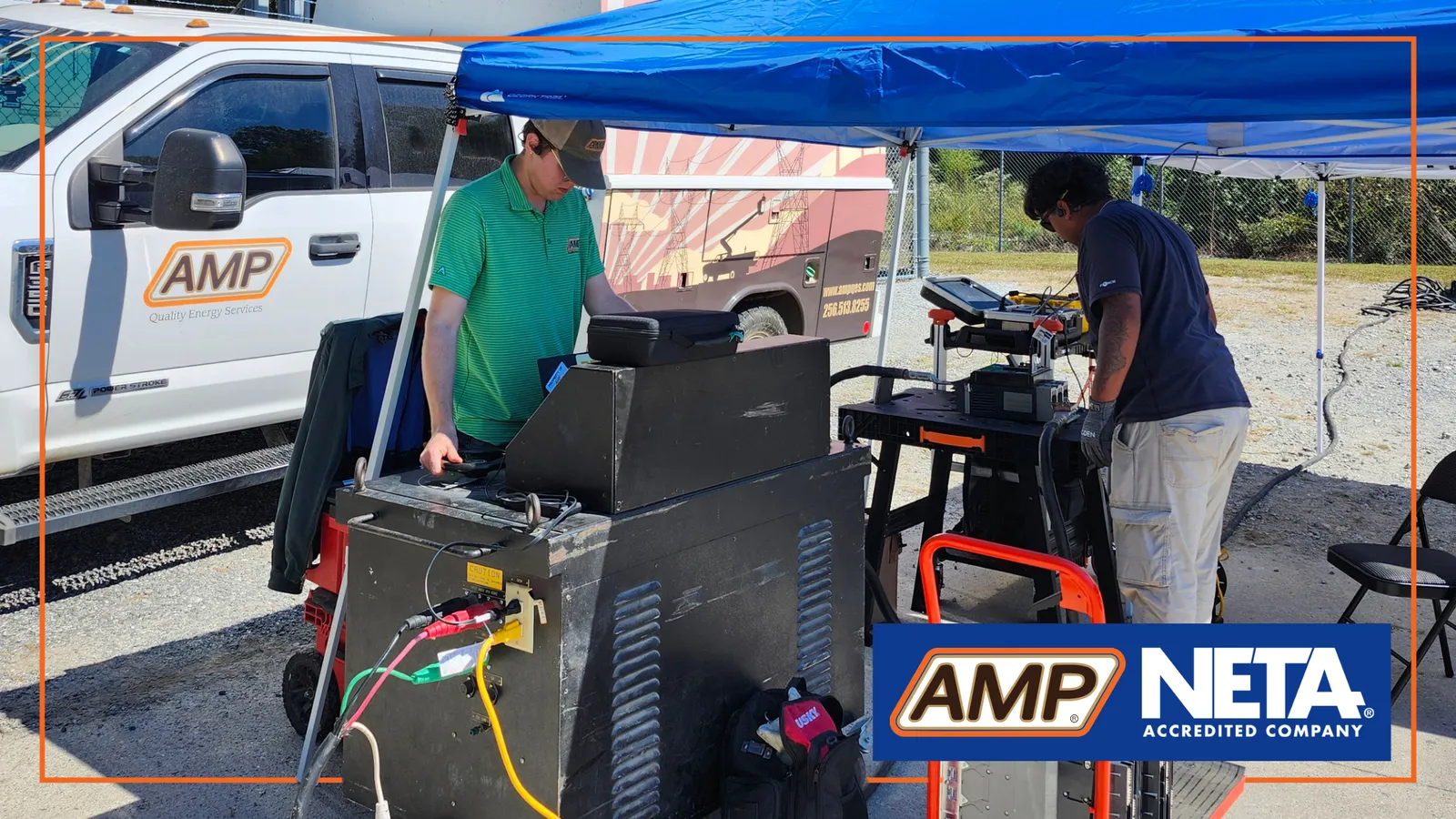
When it's time to test a protective device, there are two ways to do it: primary injection or secondary injection. Both will confirm that the device operates. But only one of them proves the entire chain that makes it operate: the current transformer, its wiring, the relay, the trip circuit, and the breaker itself.
So which one should you use? It depends on what you need to prove. Let's break down how each method works, what each one catches, and how to pick the right one for the job.
What's the difference?
It all comes down to where the current is injected.
- Primary injection drives current through the primary conductor, through the CT, just like a real fault would. Every element between the bus and the breaker contacts is part of the circuit being tested, so the primary current path is proven end to end.
- Secondary injection skips the CT entirely and injects current straight into the relay or trip-unit terminals. It tests how the relay or trip unit responds, and that's it.
Side by side
Primary injection
- Injects at: The primary conductor, through the CT
- Proves: CT ratio and polarity, secondary wiring, relay, trip circuit, and breaker
- Current: Hundreds to thousands of amperes
- Equipment: High-current set, heavy cables, cart or trailer
- Setup: Slow. Requires bus work, connections, and an outage
- Best for: Commissioning and post-modification proof
Secondary injection
- Injects at: The relay or trip-unit terminals
- Proves: Relay or trip-unit response only
- Current: A few amperes
- Equipment: Portable relay test set
- Setup: Fast. Just run leads to the terminal block
- Best for: Routine calibration and curve verification
Keep reading
Enter your email to read the rest of this article. One signup unlocks every article on the site.
What only primary injection finds
Because primary injection pushes real current through the whole system, it catches problems that secondary injection never sees. That includes:
- Shorted or open CT turns
- The wrong CT ratio installed
- Reversed polarity
- A shorting screw left in the terminal block
- Loose secondary wiring
- A trip circuit that has never carried real current
Any one of those can keep a breaker from tripping when it matters, and a relay that tests perfectly at its terminals won't tell you a thing about them.
Where secondary injection wins
That doesn't make secondary injection the lesser test. Since it only needs a few amperes at the relay terminals, a portable set can do a lot:
- Sweep the full time-current curve
- Verify pickup and timing at many points
- Exercise instantaneous and short-delay elements
- Check communications and metering
It's faster to set up, and it's the natural choice for routine calibration and periodic maintenance.
Which test, when?
Here's the simple way to decide. Start with one question: is this a new or altered CT circuit?
- Yes (commissioning, a rewire, or a new CT): use primary injection. It's the only way to prove wiring that has never carried fault current. If you don't have the space or capacity for a primary shot, use secondary injection plus a CT ratio test.
- No (an established installation): use secondary injection. Sweep the curve and log both the as-found and as-left results.
Can't do primary? When primary injection is impractical, secondary injection plus a separate CT ratio and polarity test covers most of the same ground.
Know your test sets
Different jobs call for different equipment. Here are the common portable field sets and where each one fits:
- High-current primary set (1,000 to 15,000 A, primary method): Full-loop proof at commissioning, testing the breaker and CT circuit together.
- Relay test set (0 to 60 A, multi-phase, secondary method): Pickup, timing, curve sweeps, and multi-element relays. Three-phase systems with both voltage and current outputs handle full curve verification.
- Breaker trip-unit kit (0 to 1,000 A, secondary method): Low-voltage power breaker trip units at the test port, covering pickup, long delay, short delay, and instantaneous.
- CT ratio / polarity set (low-voltage excitation, primary method): Ratio, polarity, and excitation when a full-current shot is impractical.
Solid-state trip-unit test sets are worth knowing about too. They can read and verify stored settings and test data.
Output figures are typical ranges for portable field sets. Always confirm against the nameplate and duty cycle of the set in hand. High-current sets are rated for short duration, so plan the shot before you energize.
The bottom line
Secondary injection tells you the relay works. Primary injection tells you the whole protection system works. For routine maintenance on an established installation, secondary injection is fast, thorough, and the right tool. But any time the CT circuit is new or has been disturbed, primary injection is the only way to know the system will actually trip when a real fault comes through.
- ANSI/NETA ATS: Standard for Acceptance Testing Specifications for Electrical Power Equipment and Systems.
- ANSI/NETA MTS: Standard for Maintenance Testing Specifications for Electrical Power Equipment and Systems.
- IEEE C57.13: Standard Requirements for Instrument Transformers.
- IEEE C37.20.1 / C37.90: Low-voltage switchgear and relay standards; manufacturer instruction manuals.